





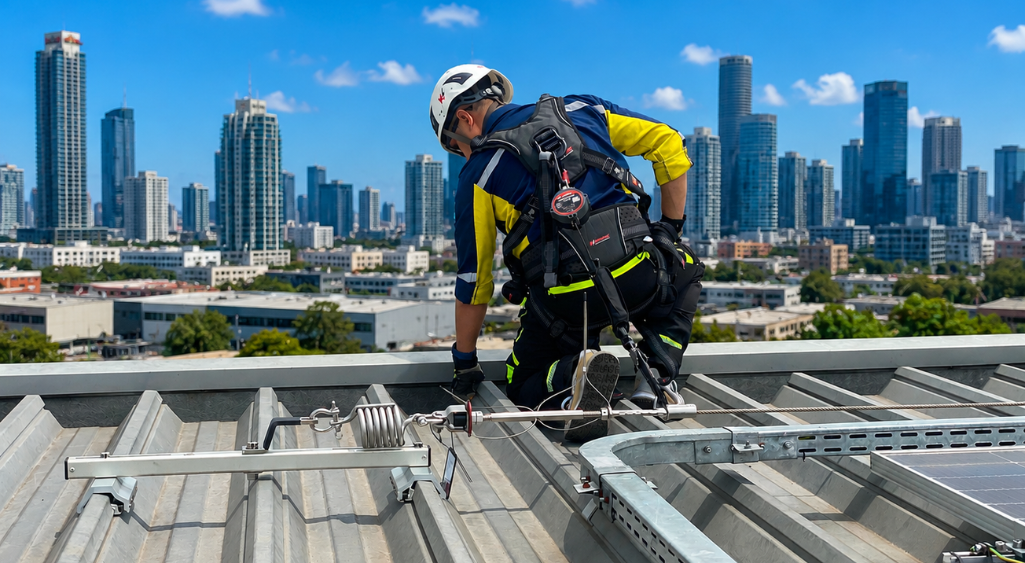
When working at height, the location of the anchorage point can change how a fall arrest system performs. An overhead anchor is generally chosen because the connection is above the head and free-fall distance can be kept low. On roofs, concrete decks and steel structures, however, the suitable attachment point may be at or near foot level.
Why Does Anchor Height Matter?
The position of the anchor affects the geometry of a fall. With an overhead anchor, potential free-fall distance can generally be kept lower. With a foot-level anchor, the worker may fall past the level of the anchorage before the fall is fully arrested.
This can increase the distance travelled during the fall and the clearance required below the worker. It also changes the angle at which the lifeline and SRL are loaded. These differences become particularly important where there are structural elements, equipment or lower levels beneath the work area.
Understanding Foot-Level Anchorage
Foot-level anchorage means connecting the fall arrest system to an anchor positioned at or near the worker’s feet, rather than above the worker. An overhead anchorage is generally preferred, but it is not always available. On roofs, concrete slabs, steel structures and similar work areas, the available anchorage may be located at or near the working surface.
In such situations, foot-level anchorage may be required. However, this does not mean that any fall arrest equipment can simply be connected at a lower point. The anchor, connecting equipment and surrounding structure must be assessed together, particularly where the worker could fall over an edge or strike an obstacle. The fall arrest equipment must also be suitable for foot-level use.
Overhead vs Foot-Level Anchorage
| Factor | Overhead Anchorage | Foot-Level Anchorage |
| Anchor position | Above the worker | At or near walking surface |
| Free-fall potential | Lower | Greater |
| Clearance requirement | Generally lower | Generally higher |
| Edge interaction | Generally lower where the lifeline remains vertical | Potentially greater where the lifeline passes over an exposed edge |
| SRL selection | Approved for overhead use | Specifically approved for foot-level use |
The Sharp-Edge Challenge in Horizontal Applications
Foot-level anchorage and sharp-edge exposure often occur together, but they are not the same. When an anchor is positioned near the working surface, the lifeline may extend horizontally between the anchorage and the worker. If a fall occurs over the edge of a roof, deck, steel structure or concrete slab, the lifeline may come into direct contact with that edge while the fall is being arrested.
An SRL does more than simply connect the worker to an anchor. Its lifeline extends and retracts as the worker moves, while an internal braking mechanism activates during a fall. If a fall also occurs over an edge, the lifeline may be subjected to both fall-arrest forces and direct edge contact.
The edge can abrade, damage or cut the lifeline during a fall, particularly when the lifeline is loaded directly against the edge. A conventional overhead SRL should therefore never be assumed to be suitable for foot-level or sharp-edge exposure simply because it has an energy absorber or meets a general fall arrest standard.
From Risk to Reality: Falls from Height in Asian
While fall protection requirements vary across regions, the underlying risks associated with working at height remain consistent. Recent, well-documented example: across Asia 32% to 46% of occupational worker fatalities and making falls from height the leading cause of fatality in Asia, many of them in the construction sectors.
KStrong BRUTE and MICRON: Matching the SRL to the Application
Because foot-level anchorage changes the conditions of a fall, the selected SRL must be designed and approved for the intended anchorage position and work environment.
Within the KStrong range, BRUTE SRLs are available in multiple wire-rope and webbing configurations, including specialised sharp-edge models for applications where edge interaction may occur. The compact 2 m MICRON range is designed for foot-level anchorage and applications such as EWP baskets, where conventional overhead anchorage may not always be practical.
Applicable requirements vary by market and model. Depending on the intended market and specific product, KStrong SRLs may be certified or tested to requirements including ANSI Z359.14-2021, EN 360:2023 and AS/NZS 1891.3:2020. Regardless of the standard, foot-level suitability, horizontal use and sharp-edge capability must be confirmed for the specific model and should never be assumed to be interchangeable approvals.
Planning a Foot-Level Anchorage System
Selecting a suitable SRL is only one part of the process. The complete fall arrest system must also account for the anchorage, available clearance, worker movement and the possibility of edge exposure.
| Check | Why It Matters |
| Manufacturer approval | Confirms the SRL is permitted for foot-level use |
| Edge capability | Needed where the lifeline may load over an exposed edge |
| Fall clearance | Must account for anchor height, worker position, device performance and obstacles below |
| Anchor strength | Must meet the applicable regulatory or system-design requirement |
| Setback from edge | Can affect fall clearance, swing-fall exposure and edge loading; follow device-specific instructions. |
| Swing-fall exposure | A fall away from the anchor line can cause impact with the structure |
| Rescue plan | Fall arrest stops the fall; it does not complete the rescue |
Equipment Must Match the Application
An SRL should never be selected only by its length or load rating. Anchorage position, possible edge exposure, required fall clearance and manufacturer instructions must be considered together.
Where foot-level anchorage or potential edge exposure forms part of the application, purpose-designed models within KStrong’s BRUTE and MICRON ranges provide options for these more demanding fall-arrest conditions. Selection must still be based on the exact model, approved anchorage position, applicable regional requirements, available clearance and manufacturer instructions.
Foot-level anchorage is not simply another tie-off position. It changes the geometry of the fall—and therefore the demands placed on the entire fall arrest system.